The Moneywise Case Study: How Audience Obsession Turned YouTube Growth Into $2.5M Pipeline
Contents

Author
Jackie Lamport
Head of Growth Marketing
Hey, I'm Jackie! I play a lot of soccer but have to call it football because I live in Europe. I also play guitar but they don't have another word for that one.
Sam Parr was successful long before he came to us at Lower Street. In podcasting no less. In the founder content niche, Sam's podcast My First Million had already cemented its place as a revered giant. He had spent years supporting, listening, learning, and being an active leader in the founder community.
We got to work with Sam a lot, very closely, and I grew to like him a lot. As a character, he's charismatic, blunt, excitable, and infectiously driven. It's no surprise to me that he found purpose in the founder community. So much so that he built Hampton, a community for high-net-worth founders so they could have a place to share ideas, problems, solutions, and connect.
For a while, his podcast My First Million was a fantastic lead generation channel for Hampton. Yes, a lot of the audience were aspiring founders, or far too early in their journey to benefit from Hampton. But in the early days, there was still enough of an audience that he was able to start building Hampton off the back of his existing, credible, and respected personal brand.
But there was a problem.
My First Million preceded Hampton. The audience overlap was enough for a bit, but it was always temporary. Unless they pivoted that show to a graduated audience more in line with Hampton's target buyer profile, it wasn't a long-term marketing strategy. In addition, the podcast isn't just Sam's, it’s a joint project, and the show wasn't built around Hampton, so, it would always feel like a sales push when he talked about it. Most importantly, that show wasn’t contributing to the Hampton brand identity.
Sam needed a branded podcast, one that was built specifically for the community of Hampton. Content for existing members to get value from and take part in, and reach potential members by speaking directly to their problems in their language. So he came to us.
What we found was that a lot of content in this space felt low-brow, or at worst outright scammy: get rich quick, hustle harder, the kind of stuff the Hampton audience had well and truly outgrown.
Here’s What We Built
Moneywise was designed as a podcast specifically for Hampton, meant to build the brand identity, without feeling too sales-y (at least, not obviously).
Right from the very beginning, we thought everything through from the listener's perspective. Not what Hampton wanted listeners to know about Hampton, but a piece of content that was made to be valuable for them, the listener. Moneywise was the show, Hampton was just the community that brought the valuable content to the audience.
Before we could figure out what that show looked like, we did what we always do– we looked at what already existed. What we found was that a lot of content in this space felt low-brow, or at worst outright scammy: get rich quick, hustle harder, the kind of stuff the Hampton audience had well and truly outgrown. It wasn't that they weren't interested in money topics. It was that the content wasn't built for them. They were completely underserved, and the gap was obvious.
So we looked at what actually resonated with people who were serious about this stuff– financial and business publications, highly produced podcasts like Masters of Scale, editorial formats that treated their audience like intelligent adults– and we decided to meet them there.
This meant no bull, human-to-human conversation, but elevated and approached with the same journalistic rigour you'd expect from a publication the audience respected. We wanted to take the topic as seriously as they did, and build a show that treats them like the sophisticated operators they are, associated directly with Hampton.
The Result / Moneywise’s Success
The first episode performed incredibly well. It had 13,000 views on YouTube in the first 48 hours, and saw about 10-15k listens in the first week. But this was just the beginning. A hot start doesn't automatically translate into sustained engagement, we still had to build that. This was just the early signal that we were on to something.
Spoiler alert, the show did turn out to be a huge success.
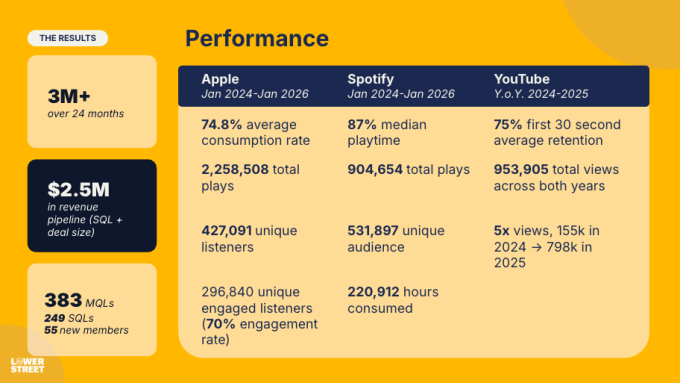
Over 24 months we hit over three million listens, 74.8% average consumption rate on Apple, 87% median playtime on Spotify. YouTube grew 5x year over year, 155k views in 2024 to 798k in 2025.
And of course, this content was made with a goal of lead generation for Hampton, so we tracked everything alongside those KPIs the whole time. The conservative estimate is (only tracking directly from Moneywise leads) 383 MQLs, 249 SQLs, and 55 new members. $2.5M in revenue pipeline.
Within the first 6 months of running the podcast, 60% of guests had themselves become Hampton members.

The success of the show comes down to a lot of useful strategies and learnings that we will detail here, but there is a single through line that impacted every single decision we made, and it was always this: we never stopped obsessing over the audience. We always approached it as a two-way relationship.
We were trying to deliver something that was meaningful and valuable to them. We spent a significant amount of time learning about, listening to, and adapting to them. That approach was especially important when we started posting video to YouTube, which gave us a new, different audience. The video one. Lots more on that.
The Main Phases of Building Hampton’s Moneywise
To show you exactly what we did to make this show so successful, it’s best if we break this down into the three main phases of Moneywise.
First, there was the journalistic, voiceover-heavy, audio-only version of the show. During that phase, we averaged around 7–10k downloads per episode in the first week. YouTube views sat around 2–3k per episode, with people exclusively listening on the platform, but the content wasn't yet designed for the platform, and growth was slow.
Second,we added video officially, though the format of the show stayed relatively the same. During that phase we grew to an average of 10–15k downloads per episode in the first week, and YouTube views grew to 3–20k steadily. But this is where you start to suddenly see anomalies. Some videos took off, reaching new people, and growing the channel baseline in bursts.
The third was the phase where we leaned into the learnings from YouTube more specifically. This is when we started experimenting with formats, analyzing the stats more strategically, and updating our video packaging. As a result, we drastically grew our baseline, and had multiple videos go viral. First week averages climbed to 15–20k downloads and 5–100k YouTube views (including one that ended up at just under 300k views and is still bringing in new viewers).
Phase 1 — Audio only
The whole first phase came down to one thing: we thought first about what our audience would want from us, rather than what we wanted them to know about Hampton. Whatever we made needed to be something they would naturally find themselves listening to, and it had to be meaningful.
We had an early cheat code here. The audience we wanted was exactly the profile of Hampton members. Naturally, we utilized the community to learn about what they were connecting with most. What were the problems that come up again and again? What were the topics that inspired a lot of people to share their own experiences? What kind of content were they already talking about? And what were they saying about it? How did they speak to each other?
Outside of these community conversations, we scraped Reddit in subreddits like r/fatfire, r/personalfinance, r/financialindependence, r/Entrepreneur, and r/HENRYfinance. We were looking for the same things: the threads that generated the most conversation, the repeated questions, the things that were already answered and the ones where we had an opportunity to add new value, the things people were fired up about, etc. Then, we did the same on LinkedIn and X on top of that.
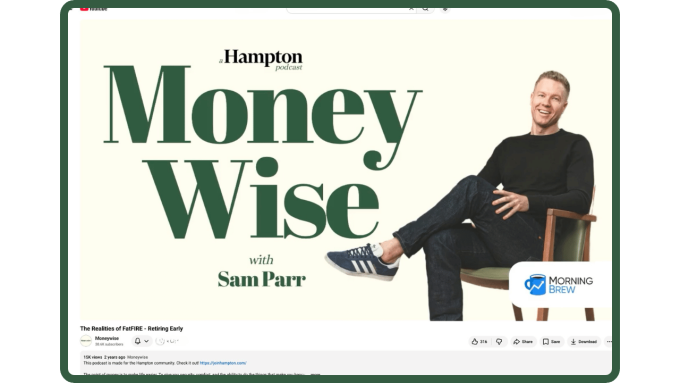
We settled on a heavily narrated, journalistic style format throughout episodes to get the audience the content they wanted. While the show was audio only, at this stage we still posted the audio file over art, and eventually a waveform animated picture on YouTube.
On the analytics side, we were heavily focused on consumption rate across the RSS platforms. Our focus was never just getting people through the door to listen, it was making sure that once they were there, the content was resonating, and consumption rate shows you that. Downloads (though still important) were always secondary, more of a reach signal.
So in addition to all the signals we were getting from the community channels, the Reddit threads, and the direct messages we were getting, we had the data to back it up too. Our consumption rate was sitting at a solid 80-85% and that told us the format was working and the content was landing.
We were also tracking YouTube views and average view duration alongside all of this, but we weren't putting serious effort into the platform quite yet, we were still getting to know it, so those stats sat more in the background and would start to play a bigger role a little later.
In this phase, we averaged around 7–10k downloads per episode in the first week and saw steady growth. Hampton's internal ROI tracking was also showing early success and growing. It was working.
That early success also became a way to increase Hampton's ROI. The team began selling host-read ad spots on the show, which resulted in roughly $300k a year. The show had paid for itself before even accounting for the leads.
Sam was happy.
I'm not being paid for this, they've not asked for it...I'm only sharing because I'm a happy customer:
— Sam Parr (@thesamparr) May 9, 2024
LowerStreet produce MoneyWise. @podcastharry is the founder.
They are SO good and make making a narrative podcast SO easy.
If you're a bigger company looking to make a pod,…
Phase 1 Stats in Brief:
7–10k downloads per episode in the first 7 days
2-3k YouTube views per episode in the first 7 days
Phase 2 — Adding video, and learning a new audience
The YouTube audience was right in front of us, but at this point, we had yet to prioritize the platform. We weren't yet sure that the audience we might attract on YouTube would be as valuable, but the growth potential of the platform was too much to miss out on, so we decided to add video.
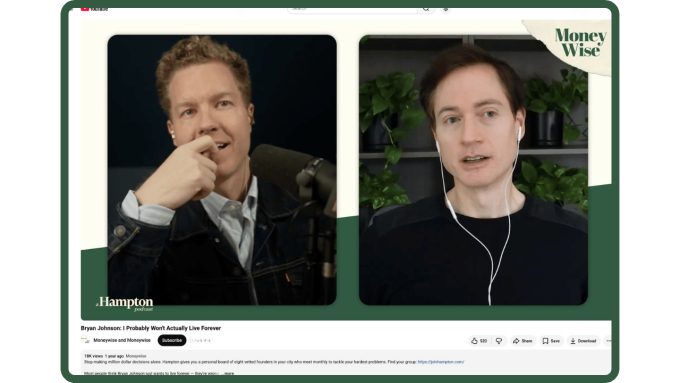
With the newly added video production, we also started optimizing our titles separately from the RSS feed versions, we monitored the comments closely, and tracked if leads increased when we saw growth, making sure that the platform wasn't only providing meaningless reach rather than impact.
During this period, downloads climbed to 10–15k in the first week per episode. YouTube views moved to 3–20k. This was also the time when we started to see the spikes that were separate from the baseline.
We discovered that with YouTube’s algorithm and lack of automatic downloads, the analytics were telling us which videos were resonating in a more obvious way than RSS ever could. With RSS only, the habitual, non-algorithmic culture of podcast platforms, growth is always steady, consistent and listeners are loyal. But because YouTube is constantly testing each video and pushing your content to new audiences, the spikes can put data in your face in a way that Apple Podcasts and Spotify analytics don't. We were able to understand which content was working, and which wasn't, faster.
However, now that we were on a new platform, we had to understand the behaviour of our audience there too if we wanted to truly see the benefits, benefits that we were already getting a taste of. The things that are respected and worked in the audio version weren't working the same way on YouTube. So we had to understand: which platform do we want to cater to more? Do we need to simply adjust the content and do both? What's the value of all that?
We had to sit with those questions while balancing the comments we were getting on YouTube, which looked completely different from the DMs and feedback Sam was getting from the RSS audience. They were telling us they wanted less narration, more raw content, like what the other channels they watched were doing. It was an active choice early in the format discussions to avoid the raw cut format, to be the elevated option in this niche, and to show that we were thoughtful about the content we delivered. We decided in this case to continue with our format with only slightly less narration.
Before we could make that content choice we had to understand whether more views meant connecting and converting the right people. We didn't want to fall into the trap of chasing views rather than results. We kept a close eye on demographic stats, scoured the comment sections not only to see what people were saying, but to see who was saying it, if they were even the right target, and made sure that the bigger reach was actually translating to more leads. That was something we wanted to follow closely as we made the pivot.
While we decided to stick closer to our original format, we did make adjustments to the video version to optimise for the platform. On YouTube, the algorithm wants to see that once people click on your content, they stay. The first 30-60 seconds is the most drastic drop-off point for any video, but if you can get a viewer to stay past that point, their chances of staying significantly increase, and YouTube rewards the video if you can keep people hooked. Every second counts. So we made unique intros for YouTube.
The benefit of YouTube as a platform is the discoverability and the reach, but that is directly because the culture of the platform is to discover, hence being crowned the second largest search engine. What this means though, is that audience behaviour is to click around. Just because they've clicked on your video, doesn't mean they've decided to watch it yet. Your intro is your pitch to get them to stay. You need to immediately confirm they are going to get what they clicked on, sell them that you have real value to add, and that they'll enjoy getting that value. The intro is more of a pitch than it is the beginning of the video. So we started approaching the intros this way. I’ve made a video detailing the strategy here.
Before we were sitting at 45-55% average viewership at the 30-second mark, which is pretty much the benchmark for large channels. When we changed the intros, we increased that to between 65-75% consistently.
We also cut the outro wrap up from the video versions. If you lose people's attention while doing a wrap up and CTAs (something that is culturally expected and enjoyed among audio platforms), then they click away to other content rather than staying on your channel. The outros we did instead were fast wrap-ups that teased another video linked in the end card screen. This decreased our drop-off noticeably at the end.
Phase 2 Stats in Brief:
10–15k downloads per episode in the first 7 days
3-20k YouTube views per episode in the first 7 days
Phase 3 — Leaning into YouTube
The more we learned from the data and adjusted, the more we were rewarded. And since we kept seeing the internal Hampton metrics tracking upward, we decided to lean into YouTube even more. We started experimenting with formats, while staying within our high-quality, highly-edited style.
One experiment was a stand-alone video, exploring one specific topic further, in this case, flying private jets. We kept a podcast-format (it had to be fully ingestible if you only listened), but wrote and produced from a video-strategy lens. We also recorded the intro in front of an airport. And then we went viral. The jet video ended up at just under 300k views, and in its first week it performed 32x better than our average. First week averages across the phase climbed to 15–20k downloads and anywhere from 5k to 100k YouTube views depending on the video.
After the success of that video, we continued to make videos that were informative, original data with meaningful analysis. We started repurposing reports that Hampton already had, and also made use of the new data collected from the over 100+ founders we had already interviewed for the show up to that point. This taught us that the value proposition being so clear and structured kept people interested and rewarded throughout, and left them with more concrete takeaways.
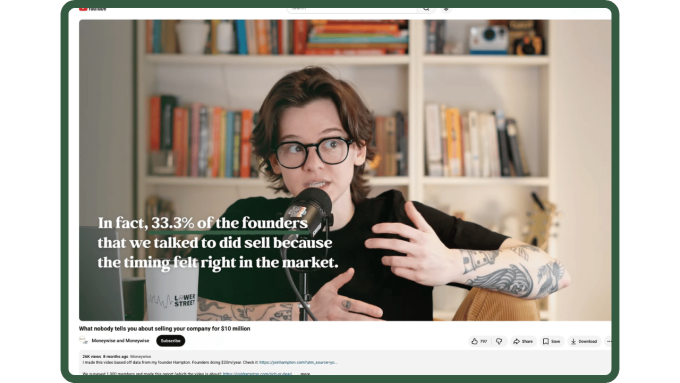
The videos worked exceptionally well on YouTube, with no negative impact on the RSS feed, and continued to drive leads. The comment section on YouTube continued to validate our choices, and consumption and downloads continued to perform. So we continued leaning into this format while keeping our original, slightly tweaked, format running alongside.
The overall thing we kept coming back to once we started leaning more heavily into YouTube, was how important it was to be direct about the value and what the audience gets out of the content. We started thinking about the piece as a promise, that’s what we sold the audience on, and the marker of good content is if we delivered it, and if we did so in an enjoyable way.
At the end of Q4, Sam decided that the company needed to go even harder on this strategy and made it the company's main focus for marketing. He built an entire content production team in house and a studio to continue the work that we'd done. Every now and then we'll send Sam an idea, and six months later they're still repurposing content we made for other content and platforms. Success all around.
Phase 3 Stats in Brief:
15–20k downloads per episode in the first 7 days
5-100k YouTube views per episode in the first 7 days
The Reason It Worked
The through line for all of it is this: we were analytical, we obsessed over the audience, and those two things were never separate from each other. We scraped online communities and forums looking for what they were actually talking about, we encouraged two-way conversation and listened closely to feedback, and we listened to each episode post-publish and asked ourselves, would I want to listen to that if I was the person on the other side trying to get value out of this?
Every single episode, we thought about not what's going to get clicks, but what's going to provide enough value that the clicks would actually convert. All in addition to analysing the qualitative data from all of the platforms and Hampton's internal KPIs.
This combined obsession over the audience, platform behaviours, and analytics; this is the answer to how you successfully take your podcast to YouTube while still maintaining and growing the ROI you wanted from the branded content in the first place.
The risk when you start chasing YouTube growth is that you get lost in it, you start growing for vanity, you blindly throw darts at a wall, and you end up with a bigger audience, but one that doesn't convert. We didn't do that, and the reason we didn't is because every decision always came back to the same question: is this the right audience, and is the reach we're seeing actually turning into results? That's why the business impact was so meaningful.
We didn’t just build a “lead gen” asset, we built a relationship, trust, and grew a community. That relationship is the most valuable asset, and it’s why Sam invested in building an entire content media department at Hampton to continue our work.
Thinking about a podcast for your brand?
If you need a partner to launch, produce, or promote your branded podcast, we'd love to help! Get in touch with us for a free consultation :).
Contact us


