This Just Proved There’s Nothing Wrong With My Attention Span
Contents

Author
Annalise Nielsen
Podcast Strategy & Development
Hi, I'm Annalise! I love terrible murder mystery books, crocheting, 70s Soul music, and trashy reality tv. I throw a mean theme party.
How Far We Have Fallen
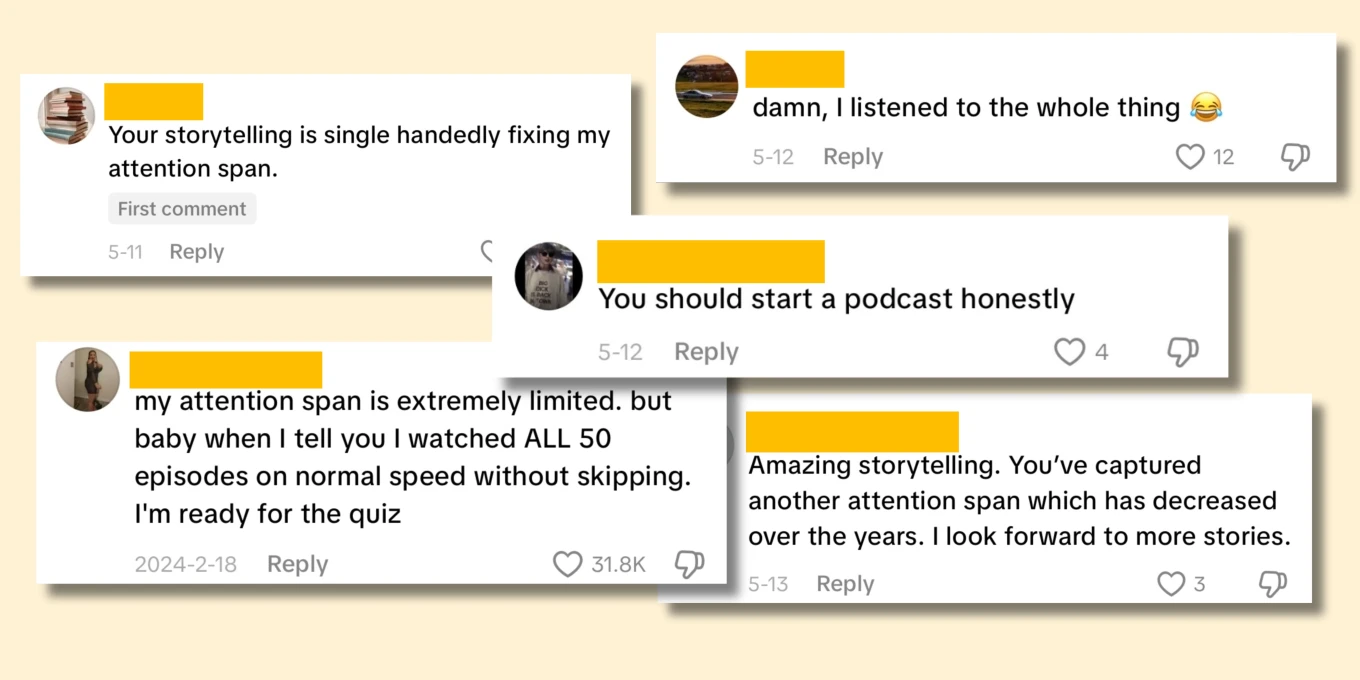
If you’ve ever watched a TikTok “storytime” longer than 60 seconds, you may have noticed a flood of comments of a certain variety: “This just proved there’s nothing wrong with my attention span.” How far we have fallen that many of us are surprised when a mere minute passes before we feel the urge to scroll away. Is sustained attention really so rare now? Recent research has found that people increasingly feel their attention spans are shrinking, with 49% of UK adults reporting their attention is shorter than it used to be. The constant hit of dopamine that comes from quickly scrolling from video-to-video is making it feel harder and harder to focus on anything longer than 60 seconds.
And brands appear to have taken notice. The reaction from brands over the last ten years has been to go shorter. That 90 second ad spot? Yeah, good luck getting someone to sit through that. If your ad doesn’t get its message across in the first 10 seconds, you can pretty much bank on a huge number of skips.
But if our attention spans are down the tubes and the only way to get in front of customers is by asking for less and less of their time, why do podcasts still see such long average consumption rates?
It’s still not uncommon to see average completion rates of 80% or more on episodes that are 30 minutes long. That’s more than 24 times the length of those TikTok storytimes that “proved there’s nothing wrong with my attention span.”
Are people really incapable of consuming content longer than 60 seconds? Or do creators just need to be more conscious of the conditions in which their audiences are consuming content?
More Is Not More
Over ten years ago I was in grad school studying documentary media. At that time, interactive documentaries were the next big thing. These were interactive web pages audiences could click through, exploring videos, photos, and text that culminated in an immersive documentary experience. The idea was that people would enjoy getting to consume the content at their own pace, choosing their own path through the story. (This was also the period of experimenting with VR documentaries, which is a whole other conversation.) More is better, no? That was an assumption a lot of people had. But then, while analyzing a specific interactive documentary, an important data point was glossed over: the documentary featured more than 7 hours of content. The average time people spent on the website?
7 minutes.
7 MINUTES. OUT OF 7 HOURS OF CONTENT.
The assumption was that giving people more and asking more of their senses would make the experience richer and encourage people to stay longer. But the opposite turned out to be true. More sensory demand meant a higher threshold to clear before people simply gave up and left.
That’s what led me to make a podcast for my final project. Stripping things back to a good ol’ fashioned audio documentary was obviously not the flashiest option. But it did ask less of the audience, not more. I put myself into the audience’s shoes and considered: if someone wanted to tell me this story, what format would I be most likely to consume it in?
The thing about (audio) podcasts is that they don’t require you to stop what you’re doing and look at a screen. You don’t have to clear your schedule and dedicate your full attention to a podcast. Podcasts were built for multitasking. And crucially, podcasts are great for multitasking tactile tasks– walking the dog, doing the dishes, driving. This means there’s no second (or third) screen competing for attention.
The problem isn’t that people are incapable of sustained focus. Longform content isn’t dead. It’s just that there is a lot more competing for our attention. Your content needs to earn audience attention, and it needs to fit in with their lifestyle, rather than competing with it.
Play To Your Strengths
Please don’t take this blog post as a condemnation of short-form video. I enjoy endlessly scrolling TikTok as much as the next person. There’s definitely a lot that short-form video and social media are good at. For example, short-form videos are incredible for discovery. It’s pretty rare that your podcast will serendipitously land in front of your target audience without you very intentionally placing it there. Social media has algorithms to get your content in front of new audiences you don’t already have access to, people who are primed to engage with it. This opens up potential for virality and huge reach.
But think of a viral video you saw in the last year. Do you know where that creator is now? Did you watch more of their videos? How many viral video creators have you never seen again?
The problem with all of this is that it’s incredibly difficult to build a long-term and sustaining relationship with anyone on social media. Influencers are increasingly feeling this. Even if you have lots of followers, there’s an increasingly slim chance your videos will land on the feeds of your followers. That multi-touch, ongoing relationship becomes a challenge. A one-off viral moment can be genuinely valuable, but if it’s not followed up with a plan for maintaining that audience connection, it’s easy for its value to crash just as quickly as it came.
That’s where the value of podcasts comes in. Podcasts afford depth. They allow for relationship building. That’s why so many influencers have them. Podcasts also allow creators to own their audience, rather than borrowing an audience that is at the whims of an algorithm. It’s not just the fact that you can keep an audience’s attention for a longer period of time with a podcast– the ongoing relationship with an audience is built into the very nature of an RSS feed. Each time a new episode is released, audiences are notified about it. It auto-populates their feeds. Listening to your favourite podcast easily becomes part of your routine. On social media, on the other hand, algorithms are intentionally filling our feeds with accounts we don’t follow (a strategic move to force influencers and brands to pay for ads).
The takeaway here is that short-form videos and long-form podcasts aren’t competing. They’re complementary, and they’re both valid responses to the rise in scrolling behaviour. But they have different jobs, and need to be measured against different objectives.
Are Clips All There Is Now?
More and more we are hearing from brands that want a video podcast (understandable and smart, given the huge rise in video podcasts in the last few years!!) But when we dive down deeper into why they want a video podcast, at the heart of it, what they really want is clips for social media. Having people on LinkedIn be aware that they have a podcast at all is sometimes the impetus for the show.
As Steven Goldstein asserts in a recent blog post for Amplifi Media, “Increasingly, the 45-second slice of video that lands on someone's phone at 9:47 p.m. is the product.” For many, the clips are the content. Goldstein writes that many of his students “consume three or four clips from a podcast, assume those are the most important moments, and feel no need to seek out the full episode.” I’ve witnessed this behaviour as well, particularly from younger audiences. If I’m honest, I myself have fallen into this behaviour too. I’ve recently gotten very into watching clips from So True with Caleb Hearon, and would now even consider myself a fan. And yet, I’m never going to listen to a full episode of that show.
But let’s dive deeper into why that is. The reality is that for Hearon’s podcast, and many others that perform very well in the clip economy, the actual long-form podcast itself is often extremely long, roughly edited, and, frankly, doesn’t respect the time of the audience. When emphasizing that clips are now the main medium for podcast consumption, Goldstein writes, “The episode is the raw material.” I think this is more than just the perception of audiences distracted by clips. This is the reality for many podcasts. Many of these heavily clipped podcasts are simply releasing their raw material as a “podcast episode”. And of course audiences are taking notice. They’re not just assuming that the clips feature all the important content– the clips really are all the important parts. There often really is no need to seek out the full episodes.
But if the entire purpose of your “podcast” is just to get some clips for social media, you’re leaving opportunity on the table at best, and risking real brand damage at worst. As I’ve stated enough times already in this blog post, long-form podcasts provide huge value that social clips don’t. The deep relationships you build through podcasts are just not replicable through clips. (The parasocial relationship I have with Jonathan Goldstein of Heavyweight is much deeper than my relationship with Caleb Hearon after watching some clips of So True.) You’re basically using a podcast simply to go viral on social media. Is this not something that could be achieved without… creating a whole podcast? It’s easy to get distracted by the clips, but these clips are only one small part of the potential value of a podcast. And if you’re not taking advantage of the long-form potential, you’re missing out.
And if you’re treating your podcast episodes as simply “raw material” from your clips, there is real brand risk here. What happens when those podcast fans go check out your actual podcast? If episodes are long, meandering, have minimal editing, and don’t respect the audience’s time, people will tune out. Your brand ends up looking unprofessional and careless.
Eating My Words (Sort Of)
Years ago I was on a panel at Podcast Movement and the subject of audiograms came up. I shared my hot take that I hate audiograms. This did not go over well with the audience. During the Q&A period I had lots of folks rushing up with angry questions: How are you supposed to get your podcast in front of more people then? How would you leverage an existing large social media following? Why wouldn’t you repurpose your content to maximize its value? What cost effective way would I suggest to get more out of your podcast, then?
A lot has changed since that panel. At the time, the majority of people were scrolling through social media with the sound off, consuming the minimal video content there without audio. Social platforms were largely for still images and text. But even today, I hate audiograms. They reflect the worst attempts at “maximizing and repurposing content”. Who wants to watch a waveform on a screen as an out-of-context piece of audio plays for 30-60 seconds?
What’s changed in these past several years is the ushering in of scrollable video. With TikTok and Reels, we’ve moved to a sound-on era. And this represents a significant opportunity for podcasts. I do see real potential in creating short-form clips from full-length video podcast episodes now. I binge-watch clips on TikTok from podcasts I never would have clicked on otherwise, and there is value in that. We just have to be very clear about what that value is, and have clear, distinguishable goals for social media that are separate from the long-form podcast.
All this being said, I still believe that “repurposing” is a trap. I’d rather think of it like “reimagining”. Repurposing is automation, extraction, and trying to squeeze more out of something made to be consumed elsewhere. Reimagining including editorial judgement, intentionality, and thoughtful consideration for audiences, wherever the content is consumed. Repurposing is an afterthought. Reimagining is done with a plan.
TLDR
To summarize, here are my hot takes when it comes to how brands should respond to our new ever scrolling reality:
Don’t give up on long-form. Just because someone can barely make it through a 60 second storytime on TikTok, it doesn’t mean they won’t listen to 80% or more of your podcast episode. It they’re skipping your ad after 5 seconds, resist the impulse to make everything shorter.
Podcasts allow for multitasking. That is their strength. If your video demands both aural and visual attention, you will likely be competing much harder to capture any of your audience’s attention at all. Creating content that can be fully enjoyed without competing for attention will help you avoid drop off.
Short-form video and long-form podcast episodes have different strengths. Both are valuable. In an ideal scenario, you can do both well. If you can’t do both well, focus on what you can do well and drop the rest. It’s better to do one thing really well, than a bunch of things averagely.
Don’t repurpose. Reimagine. Don’t treat the podcast or social clips as afterthoughts. If you’re going to have social clips for your podcasts, create them intentionally and thoughtfully. Make a plan for what kind of content will resonate with your target audience, before you even enter into production of the podcast. And think outside the box.
Stop underestimating your audience. They aren’t incapable of giving focused attention. The bar for earning it is just higher than it used to be. Create genuinely good content, and you will find that there, indeed, is nothing wrong with their attention spans.


