Zombie Channels: How Paid Promotion Kills YouTube Audience Growth
Contents

Author
Jackie Lamport
Head of Growth Marketing
Hey, I'm Jackie! I play a lot of soccer but have to call it football because I live in Europe. I also play guitar but they don't have another word for that one.
Update: Starting August 24th, a "view" has changed. I wrote about that update here: Youtube Changed What a View Is and Tracking It Is Essentially Useless Now.
Also, if you're coming from the newsletter, that link is the one you were meant to be sent to. But hey, this is a great starting point too.
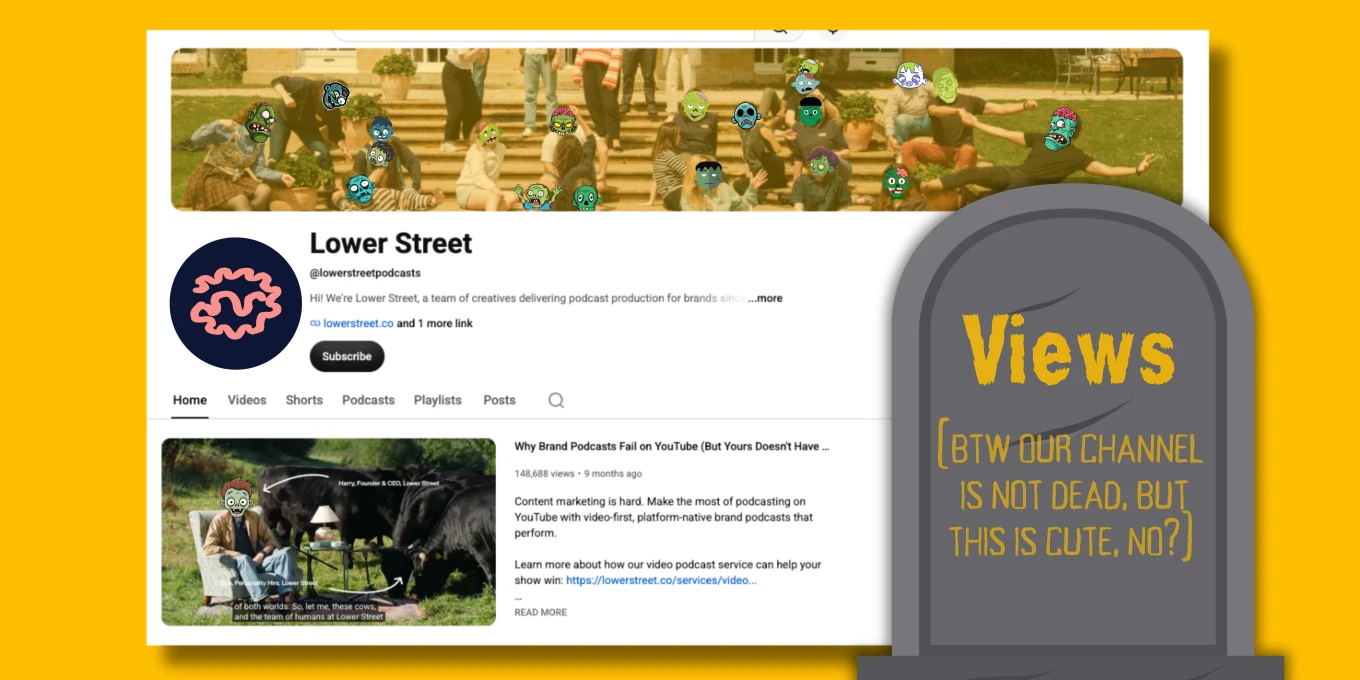
Zombie channels. That's what I'll call them. Not quite dead, but not quite alive. These are the YouTube channels that from an outside perspective, seem to be doing well. They have high view counts, consistent performance, and often an impressive subscriber count. But while these channels look very much alive, they are dead. And there is a tell.
Well, two main tells. The first tell is one that isn't visible to most people. I use an extension tool called VidIQ which displays public stats for videos that you are currently watching in the sidebar. The best way to explain it is to show you.
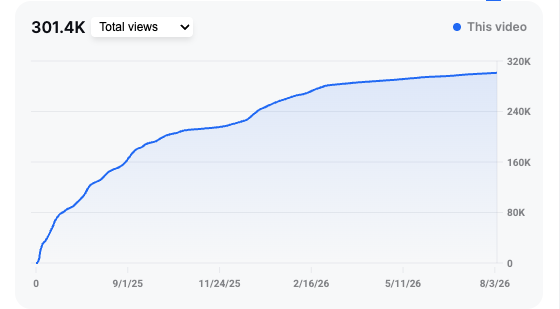
This is what a popular video with no paid promotion looks like.
This is what a "popular" video with paid promotion looks like.
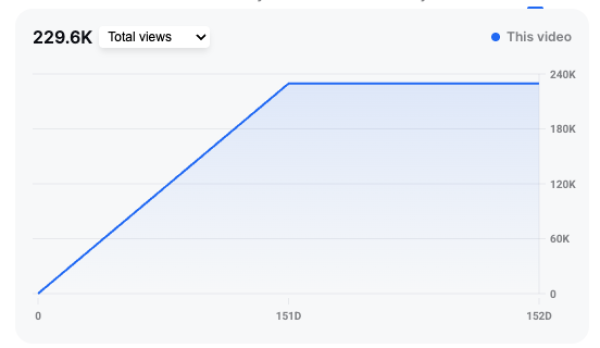
You can immediately see the difference. The organic views compound, and don't shoot up straight. The plateau is also curved and happens slowly in stages over time, never really flattening out completely. The paid video goes immediately up and then goes nearly flat with essentially non-existent continuation of momentum.
The other tell is more obvious and you can't hide from it– everyone can see it. It's a combination of high views, but no or minimal engagement (comments, likes, shares, etc.). As soon as I see that, I can already tell that as soon as I look under the hood at the traffic sources, it'll likely be around 95-99% paid promotion driven traffic.
I’m not saying paid traffic is bad. In fact, it can be really helpful. The problem is how people use it, paying for views that have no chance of growing an organic audience for real. And most branded channels that I come across are using it in a way that is not only ineffective, but is also harmful to the channel. Harmful to the point where it can kill organic traffic completely and render the channel another body in the undead army of YouTube zombie channels.
What paid promotion on YouTube actually is
To clarify, paid promotion is simply paying YouTube to put your video in front of a target audience. That can be in the form of “sponsored” video suggestions, or playing your video as an “ad” in-stream. You can choose to have Google's algorithm reach that audience directly based on demographics and interests, or you can hand pick and target a placement directly on specific channels or videos (usually competitors, or wherever you know your audience is already hanging out).
There are a few different types of ads you can buy. I’ll break them down here.
In Feed Static Visual Ads
This is the most common for video promotion specifically, and it’s less dangerous than the practice of “buying views” via the other type of paid promotion. These are ads of your video’s packaging that that show up in search and suggested videos, the same way a non-promoted video would be but with an identifier that says “sponsored”. Because someone has to click, there is better intent than a forced viewing, but when these are un-targeted or vague, these clicks (sometimes even accidental) result in poor engagement. This is the danger. More on that in the next section.
Skippable In-Stream Video Ads
These are video ads that play before or during a user’s video playback, and they work by playing the video you are promoting. They are skippable typically after five seconds (you’ve gotta hook early!). The upside though, is that it’s a cost-per-view model. You only pay if someone watches 30 seconds (or the whole thing, if it's shorter), so you're paying for attention, not just an impression.
Non Skippable In-Stream Video Ads
This type is similar to the previous one, with an obvious exception… the viewer cannot skip them. That means the ads need to be between 7-15 seconds, unless it’s a bumper in which case it has to be max 6 seconds. Because of the length limitations, these are used more specifically for ad ads, but while this type cannot use and promote an entire video, it can be used to serve trailers for your content.
I’ll stop myself before I go down a rabbit hole of all the things you could do with these ads (there really are so many) because the reality is that most branded channels aren’t using these in an effective way.
The problem is that the majority of branded channels rely on general Google Ad knowledge and not YouTube knowledge, therefore missing the opportunity, often wasting money, and, yes, ultimately creating an undead channel.
Let's understand how that happens.
How paid promotion can kill your YouTube channel
There was a misconception that floated around a few years ago that YouTube penalized channels that used paid promotion rather than organic growth, meaning that it would deprioritize those videos in the algorithm. YouTube responded in 2025 by stating that their algorithm uses no such bias, and that paid and organic views are run by two separate systems. Therefore there is no organic view suppression on videos using paid ads. This is what YouTube and Google Ad reps will tell any marketer that expresses concern. And it is technically true. But it's misleading.
The reality is less black and white. The algorithm isn't penalizing channels for paid views, they are penalizing channels for bad stats, just like it would any other video.
YouTube's end goal is this – keep users on the platform. It likes videos that people click on and stay watching. And it especially likes videos that keep people on YouTube– if people stay long enough to click on other videos after watching yours, that’s going to help you with the algorithm. Your content resonating and being engaging is what it takes to win in the algorithm. Simple. But think about it, what video is a user more likely to stay watching? One they chose, or one that was put in front of their face and "forced" on them?
The thing is, just like YouTube says, it doesn't have a bias against paid or organic views. But what that platform has not stated whether it counts the engagement stats driven from those views. Because of that, it's best to assume it does. Which means if your video is relying on a ton of paid traffic (especially targeted at the wrong audience), the resulting poor consumption rate and overall bad engagement is telling YouTube that the video isn't resonating, effectively killing its chances with the algorithm. After that happens, the only way you can get views is by paying for them.
Even more dangerous is when you put a video out and give the algorithm no time to find the correct audience by promoting the video immediately. The video never even has a chance. This then has a compounding effect.
You see, YouTube is doing its best to work with you to build an audience for your content. When you start building a channel, you are looking to reach the best possible fit early so you can determine the type of user who is engaged and derives value from your content. Think about why the starting out advice “find a niche” is so common– once YouTube learns who your audience is, it uses that as the foundation for every new video you put out. When you upload, that video gets first tested with an audience that is primarily your engaged, returning viewers. If they click on it and enjoy it, then YouTube sees potential in the video and pushes it out to adjacent audiences, which is how you collect new viewers. If it performs well with them, it will keep pushing the video out to more and more people. When it does really well, it just keeps getting pushed, and you get those anomaly videos that end up being the Hallmark drivers of major growth.
The key detail here is that YouTube is collecting this information about your audience through your previous videos. So when you confuse the algorithm, you don't just do it for a single video, you do it for the whole channel. If YouTube can't figure out who your audience is, it doesn't push your content. And if it doesn't push your content, the channel is effectively dead.
This blindspot comes from a misconception about what is actually valuable on the platform.
Most marketers don't understand YouTube
The thing is, a video posted by a brand on YouTube is not quite an "ad". The power of the platform is the culture of engagement, and the ability to grow an audience, not just being “seen”. No, a video is branded content. This makes a "view" feel like a far more powerful metric than an "impression", yet, it really isn't.
The goal of branded content can be hyper specific, and goals can vary quite a lot. At the core however, growing an audience of the right people is the most powerful outcome that can drive all of those other goals. The opportunity to build connection, trust, direct access, and the ability to learn about what your target audience resonates with (and what they don't)... yeah, all of that is massive for any brand.
But somewhere along the way, we started equating raw numbers like subscribers and views as the qualifying metrics for any goal. Even a goal like deeply resonating with a nice group of people. And whether you agree with it as an honest qualifier, or you also believe that metrics are kinda broken, you still live in a reality where too many people do use these stats blindly. An executive asks your team to make a video and just wants to see a high view count, so you post it to a dead channel, pay for promotion, get the big number, send the result, and everyone's happy and then it's done. Afterwards, you question yourself: What impact did that actually have? Often the answer is… none.
That's because views (and downloads) were never the right metrics to measure meaningful impact. And of course those paid views don't have a meaningful impact on the business beyond brand visibility, because views alone never did.
I’ll be honest with you, I got a tad obsessed thinking through real, meaningful, and feasible solutions to this measurement problem. I’ve ended up with a set of metrics and simple equations to get them that specifically track organic growth impact from paid-promotion campaigns. I even designed a simple to use calculator that fills in your data for you. This has created the need for a spin-off article.
In my next post, I am going to detail how you can effectively measure a campaign’s impact, along with explaining the best practices for operating paid-ads. I’ll also provide the calculator as a free tool to use so you can check your stats right there.
With that said, I’ll leave this part here: the problem with paid promotion is not paid promotion itself. It’s that too many marketers don’t know how to use or measure it. When people optimize for the wrong metrics, or make choices without fully understanding YouTube, aid promotion is a channel killer. But when used well, it can have a real meaningful impact, and if you can track that impact properly, you can grow it.
Want to be notified when part two and the calculator tool drop? Sign up to our newsletter here :).


